

Comets
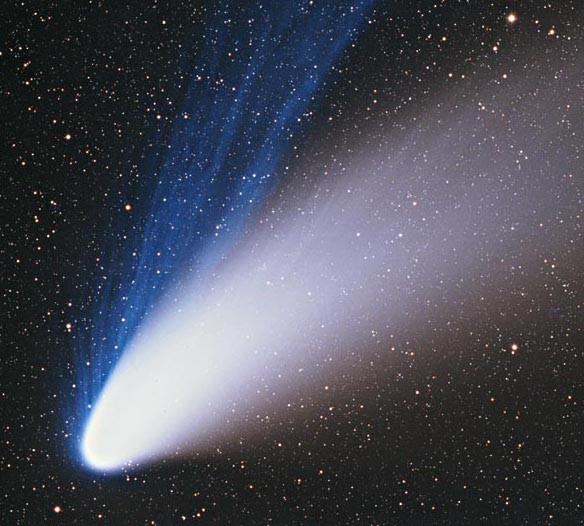
Credit: © 1997 Loke Kun Tan

Comets are large balls of rock, ice, dust and gases. They contain frozen leftovers from the early Solar System. Material that is about 4,600 million years old!
Scientists think that comets could have hit the Earth when the Solar System was very young. They may have brought water and organic compounds with them. These are the ingredients needed for life.
During most of their orbit, comets are hard to see. This is because they are small and made of dusty ice which does not reflect much light from the Sun. As a comet get closer to the Sun, the ice in the comet heats up. Some of this ice turns into a gas. The gas gets lit up by the Sun's light, making it easier to spot with a telescope.
Astronomers have discovered about 4,000 comets in our Solar System so far. Most comets come from beyond Pluto, in the Kuiper Belt and Oort Cloud. We have not fully explored these dark and distant parts of space yet. So there are probably billions more comets out there!
What are the different parts of a comet?
Credit: The Schools' Observatory
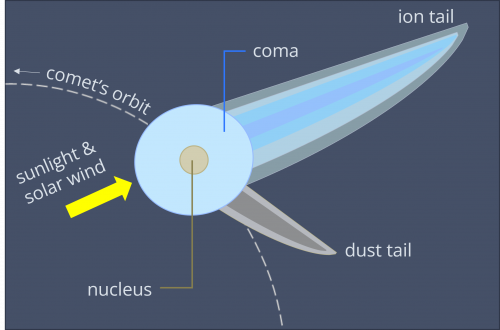
The solid centre of a comet is called its nucleus. It is made of solid chunks of ice along with frozen gases, rocks and dust. You can think of it as a giant, dirty snowball. The nucleus is usually only hundreds of metres across, but can be the size of a small town! Astronomers have seen comets releasing jets of gas and dust from their nucleus, like a geyser.
As a comet gets closer to the Sun, the ice in the comet heats up. Some of this ice turns into a gas. The gas (plus dust and some water) forms a cloud around the nucleus, called a coma. You can think of the coma as the comet’s atmosphere. The coma can be as large as a planet!
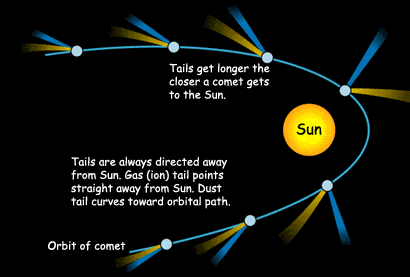
Sunlight and super-fast particles from the Sun (solar wind) can push the coma into a large tail. This tail always points away from the Sun. The gas in the tail contains charged particles called ions, so this tail is sometimes called the ion tail. Some comets ion tails are over a million kilometres long!
Comets can also leave a trail of small rocks and dust in their path. This is known as the dust tail. When the Earth passes through a comet's dust tail, debris from the comet falls through our atmosphere. This creates meteor showers.
Why do comets sometimes get close to the Sun?
Credit: NASA

Comets sometimes get close to the Sun because they have very elliptical orbits. This means that they go around the Sun in a large, stretched out oval shape, rather than a circle.
The furthest point from the Sun in an orbit is called aphelion. The aphelion of most comets is way beyond the planet Neptune.
The closest point from the Sun in an orbit is called perihelion. The perihelion of some comets can be closer to the Sun than the planet Mercury! These kinds of comets are called 'sungrazers'. These comets may end up crashing into the Sun. Or the heat from the Sun will cause them to break into pieces and evaporate away.
What are some well-known comets?
- Halley’s comet – British astronomer Edmund Halley observed this comet in 1682 and correctly predicted it would return in 1757. This is also thought to be the comet included in the 1066 Bayeux Tapestry.
- Shoemaker-Levy 9 – this comet crashed into the gas giant planet Jupiter in 1994.
- 81P/Wild 2 – visited by NASA’s Stardust mission in 2004. The spacecraft brought dust from the comet back to Earth.
- 67P/Churyumov-Gerasimenko – ESA’s Rosetta mission visited this comet in 2014 and became the first spacecraft to land on a comet.