

Jupiter
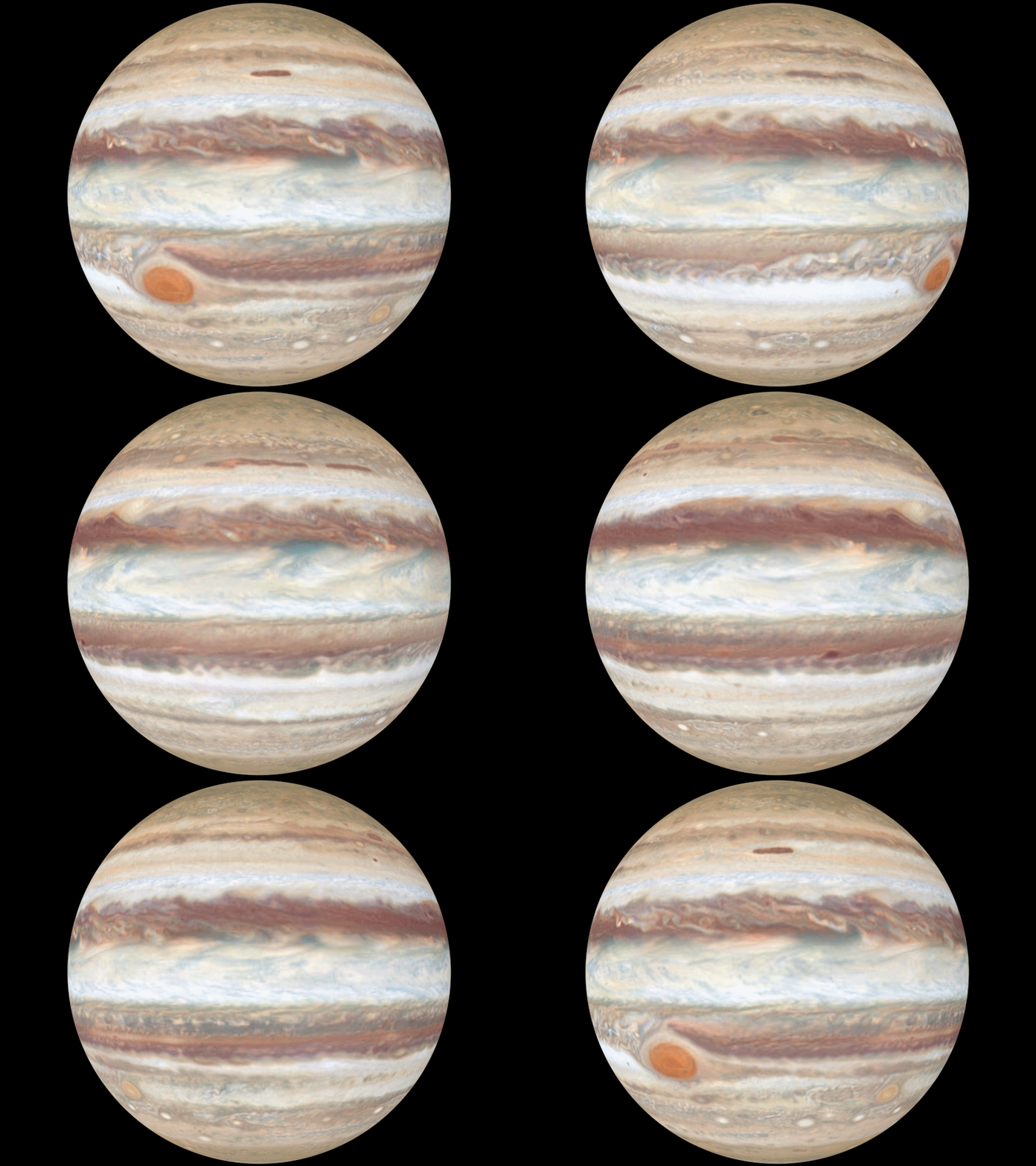
Credit: PlanetUser/NASA

Jupiter is the fifth planet from the Sun and the largest planet in the Solar System. It is more than twice as massive as all the other planets in our Solar System put together. It is so big that all the other planets would fit inside it! As huge as Jupiter is, it is only a thousandth the mass of the Sun. And 11,000 planet Jupiter's could fit inside our star!
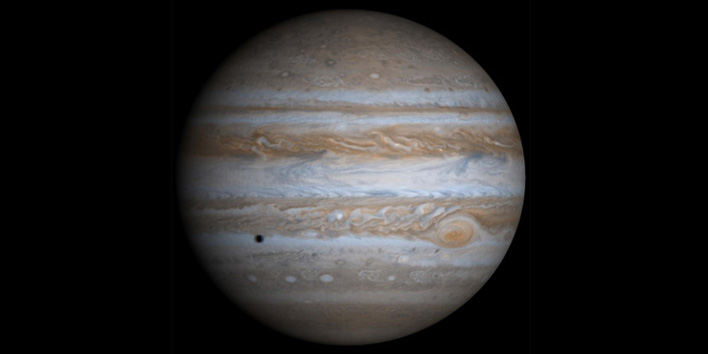
Jupiter is a gas giant planet. This means that is does not have a solid surface. It is mostly made of gas and is thought to have a small solid core. Jupiter is made up of mainly hydrogen (75%) and helium (24%). The light coloured bands of cloud are made of ammonia ice and are called zones. The darker coloured bands, or belts, are thought to be made up of sulphur, and phosphorus.
Jupiter spins faster than any other planet in the Solar System. One day on Jupiter is around 10 hours long! Even though it's day is much shorter than the Earth's its year is longer. This is because Jupiter is much further from the Sun. It takes 12 Earth years for Jupiter to go around the Sun once.
One of the most famous features of Jupiter is the Great Red Spot. This is a giant storm, which has been raging for at least 150 years. The storm is twice the size of the Earth.
Jupiter has dozens of moons. The largest four were discovered in 1610 by Galileo. They are called: Io, Europa, Ganymede and Callisto. We don't think that life could survive on Jupiter. But when scientists look for places life could live in the Solar System they often look at Europa. The oceans on Europa, under the icy crust, might be one of the best places for life to evolve.
The first spacecraft visited Jupiter in 1973. Many others have looked at Jupiter since whilst exploring the Solar System. The mission Galileo spent years studying the planet between 1995 and 2003. In 2016, the NASA mission, Juno, arrived at Jupiter hoping to get clues about how the planet formed, but we still have many questions.
Credit: NASA