

Mercury
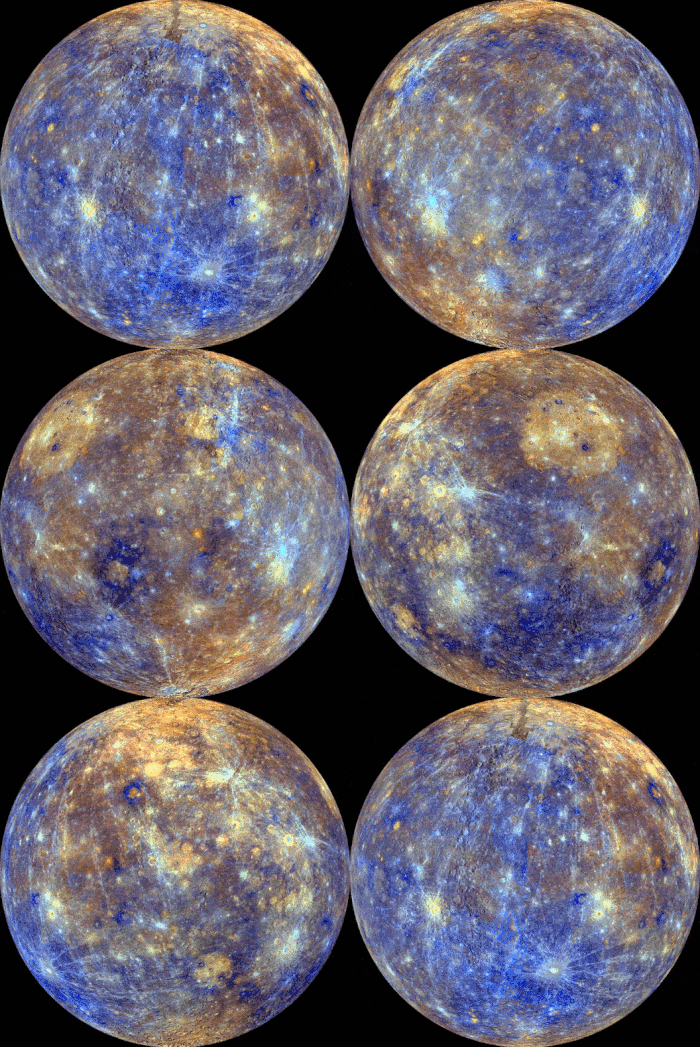
Credit: NASA, Johns Hopkins

University Applied Physics Laboratory,
Carnegie Institution of Washington.
Mercury is the closest planet to the Sun. It is also the smallest planet in the Solar System, not much bigger than the Moon. If you were standing on Mercury the Sun would look about 3 times bigger in the sky.
Mercury is a terrestrial or rocky planet, like the Earth. It is made mainly of iron, and other heavy metals and has a rocky crust. The core of the planet reaches over half way to the surface. It is the second most dense planet in our Solar System after the Earth.
Mercury is covered in craters like the Moon. Most of the craters were made billions of years ago when the Solar System was forming. Mercury is the only rocky planet which doesn't have volcanoes. This means that the ancient craters can still be seen today as the surface has not changed much since its creation. It has no moon of its own.
Mercury is small, about the size of the Moon. This means it has very little gravity and can't hold on to an atmosphere. Instead, it has an exosphere. This is a very sparse layer of atoms, mainly captured from the Sun.
With no atmosphere to help control the temperature Mercury lives with extremes. Day time temperatures can reach about 427 °C dropping to almost -173 °C at night. It is not thought that life could exist on the planet.
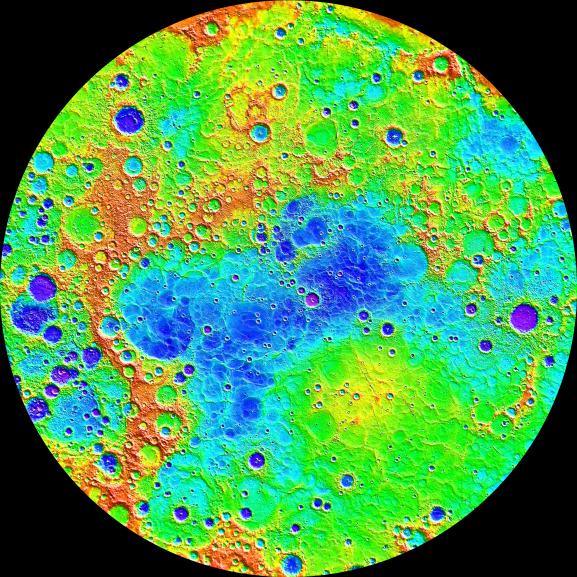
areas are shown in purple, and the
highest areas are shown in red.
Credit: NASA
Mercury is the fastest of all the of the planets. It is so close to the Sun it takes just 88 days to complete an orbit. It spins around once on its axis every 59 days. A quirk of Mercury is that each rotation doesn't see the Sun rise and set. Mercury's orbit is more squashed than other planets. This means it actually takes 176 days for the Sun to appear to rise and set. This makes a solar day on Mercury longer than its year!
The first spacecraft to visit Mercury was Mariner 10 in 1974, and it mapped around half of the planet’s surface. The next mission to Mercury didn't happen until 2004. This mission, MESSENGER, mapped the rest of the surface. A European mission called BepiColombo launched in 2018, but it';s not expected to reach the planet until 2025.