

Meteor Showers
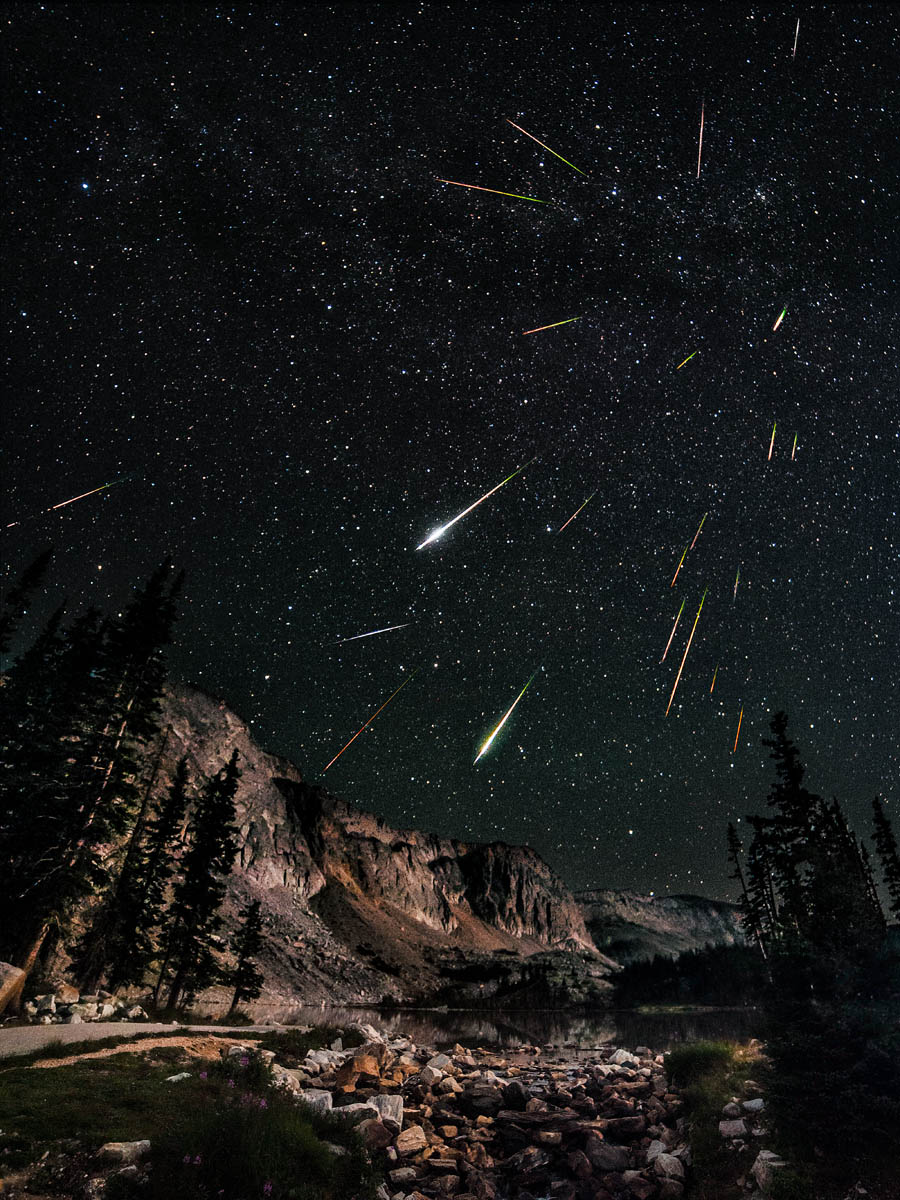
Credit: David Kingham
Meteors, sometimes called shooting stars, are not stars at all, but small rocks burning up as they fall through Earth's atmosphere. Their super fast speed through the air causes them to burn up as they fall.
The best time to observe meteors is during a big meteor shower. Although you might see a few meteors on any clear night. Meteor showers last for several nights. They happen when the Earth passes through the trail of debris left behind by a comet or asteroid. During the peak of a good shower, you may see as many as 100 meteors in an hour! However, on a typical night, you will probably see 6 meteors per hour. Extremely bright meteors often leave an afterglow along their trail, called a train.
Each day, 100 tonnes of rocks and dust enter our atmosphere. Luckily, most of these objects are so small that they burn up completely before reaching the ground. They are too small to be a danger. Some rocks are big enough that they do not get totally burnt up and reach the Earth's surface. Space rocks that land on the ground are called meteorites.
Most meteorites are pieces of asteroid. Though a few have come from the Moon and Mars! Meteorites contain a lot more metals than Earth rocks. This makes them more dense, so they will feel heavier than you expect them to be. The outside of a meteorite is usually smooth and black. This is called the fusion crust. It is made when the outside of the rock get hots and melts as it falls.
Plan your meteor spotting
You need dark skies! The less light around you the better, so try to move well away from buildings and street lights. Also, check the phase of the Moon! A bright full Moon will spoil your chances of seeing meteors. You can check today's phase of the Moon on our homepage. Make sure to wear warm clothes and be patient, you might not see any on your first try!
Calendar of Meteor Showers
| Meteor Shower | Dates of Activity | Date of Peak |
Possible |
Description |
|---|---|---|---|---|
| Ursids | 16 – 25 December | 21 – 22 December 2023 | 10 | Only a few meteors per hour. Debris from the comet 8P/Tuttle |
| Quadrantids | 28th December – 12th January | 3rd - 4th January 2024 | 110 | One of the best showers but with a very short peak of only a few hours. |
| Lyrids | 14th - 30th April | 22nd - 23rd April 2024 | 18 | About 10 to 15 meteors per hour at the shower’s peak, with a dark sky. |
| Eta Aquariids | 19th April - 28th May | 6th May 2024 | 50 | Halley’s comet is the source of the Eta Aquariid meteor shower. |
| Delta Aquariids | 12th July - 23rd August | 30th July 2024 | 25 | Observers in the Southern hemisphere will get the best views. |
| Perseids | 17th July - 24th August | 12th - 13th August 2024 | 100 | Usually the most enjoyed meteor shower for the Northern Hemisphere. |
| Draconids | 6th - 10th October | 7th - 9th October 2024 | 10 | Usually not more than 5 meteors per hour but in 2011 there were over 600! |
| Orionids | 2nd October - 7th November | 21st - 22nd October 2024 | 25 | These meteors are debris from Comet Halley. |
| South Taurids | 20th September - 20th November | 10th - 11th November 2024 | 5 | This shower has a high percentage of fireballs (very bright meteors) |
| North Taurids | 20th October - 10th December | 12th October - 2nd December 2024 | 5 | Meteors in this shower are often slow moving, but sometimes very bright. |
| Leonids | 6th – 30th November | 18th November 2024 | 10 | Bright with trains. Debris from the comet 55P/Temple-Tuttle |
| Geminids | 4th – 30th December | 14th – 15th December 2024 | 150 | Usually the strongest meteor shower of the year for the Northern Hemisphere. |
| Ursids | 17th – 26th December | 23rd December 2024 | 10 | Only a few meteors per hour. Debris from the comet 8P/Tuttle |