

Saturn
Credit:Almond/NASA
Saturn is the sixth planet from the Sun and the second largest planet in the Solar System. Saturn is a gas giant planet like Jupiter and does not have a solid surface. It is made mainly of the gases hydrogen and helium. Saturn is the only planet in our Solar System with an average density which is lower than water. This means that if you could find a bathtub big enough, Saturn would float!
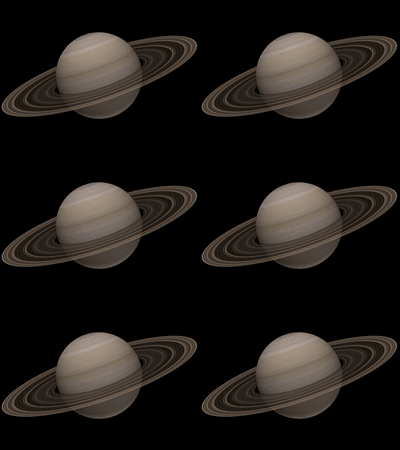
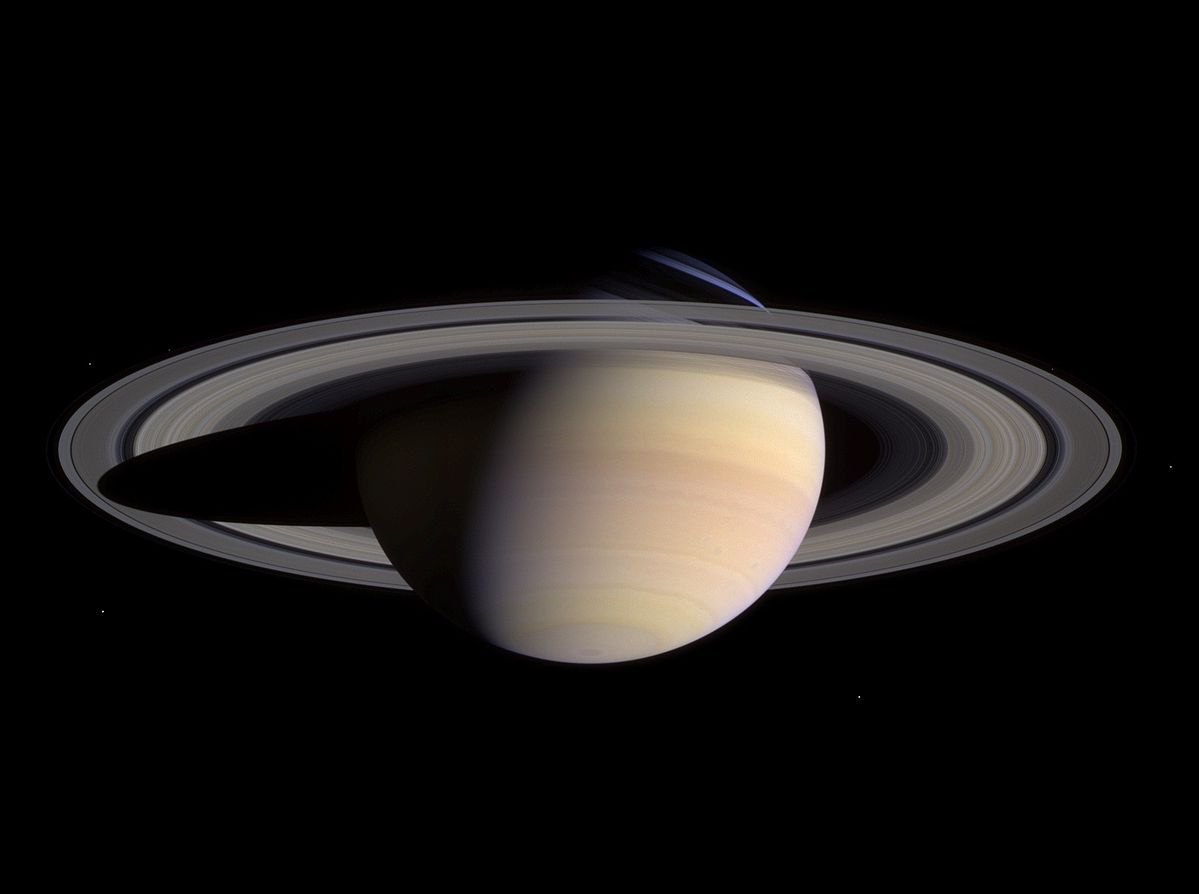
You probably know Saturn for its dramatic and beautiful rings. Saturn is not the only planet to have rings, but they are the biggest and brightest. It might surprise you to know the rings are not solid. They are made up of many millions of pieces of ice and rock! The pieces orbit Saturn to make a system of 7 rings. Each ring orbits Saturn at a different speed. The lumps of ice and rock in the rings range in size from a few centimetres to several metres across. Although the rings look impressive, they are only about 1 km thick. But they are very wide - 250,000 km in diameter!
Saturn is covered in layers of clouds that give it its yellow, brown and white stripes. Winds in the clouds can be as fast as 500 metres per second. This is faster than winds in the strongest hurricanes on Earth. Cold winds at Saturn's north pole create a remarkable hexagon shape in the clouds.
Saturn spins on its axis like the Earth, so it has day and night. It has the second shortest day of the 8 planets. One day on Saturn is about 10 and a half hours! Much shorter than Earth's 24 hours. Saturn's axis is tilted by about 27 degrees. This is similar to Earth's tilt of about 23 degree which means Saturn also has seasons! But the seasons pass by much more slowly because it takes Saturn over 29 Earth years to orbit the Sun.
Credit:NASA
As well as rings, Saturn has dozens of moons. Saturn's largest moon, Titan, is bigger than Mercury and the dwarf planet Pluto! Titan is large enough to have its own atmosphere. Scientists think Titan and another of Saturn's moons (Enceladus) have oceans beneath their surfaces. This means they could contain the right conditions for life.
The first space-probe to visit Saturn was Pioneer 11 in 1979. There have been several others since then. The Cassini-Huygens probe spent 13 years studying Saturn and orbited it 294 times!