

The Sun
Credit:SOHO
The Sun is a star at the centre of our Solar System. It is one of billions of stars in our galaxy, the Milky Way. It looks bigger than the other stars we see in the night sky because it is far closer to Earth. It is only 150 million kilometres away! The next closest star, Alpha Proxima, is 40,000 billion km from Earth!
The Sun is a spherical ball of hot plasma, 1.4 million kilometres wide. This is more than 100 times wider than Earth. It contains more than 99.8% of all the mass in the Solar System. The gas giant planet Jupiter contains most of the rest. Because it is so massive, the Sun’s gravity is very strong. Strong enough to influence objects across massive distances. It is the Sun's gravity which keeps every object in our Solar System (planets, asteroids, dwarf planets) in orbit around the Sun.
The Sun is 75% hydrogen and most of the rest (24%) is helium. These are the lightest chemical elements. They are also the most common elements in the Universe. The Sun also has small amounts of oxygen, carbon, neon and iron. Nuclear reactions deep inside the Sun made these heavier elements.
Credit: The Schools' Observatory
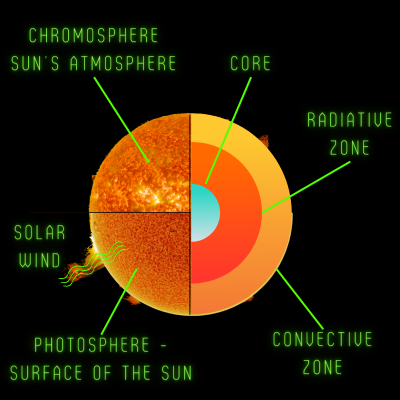
There are three main parts to the Sun. The core at its centre is the hottest part. Deep in the Sun's core, temperatures reach 15 million degrees Celsius! Around the core, is the radiative zone. Energy is carried through this area, away from the core, as thermal radiation. Around that is the convective zone. Heat moves around this zone like soup bubbling in a pot. The visible layer of the Sun is called the photosphere. The temperature of the photosphere is about 6,000 degrees Celsius and gives it its yellow colour. The Sun also has an atmosphere. Some of the Sun's atmosphere escapes into space - we call this the solar wind. It takes 50 million years for the Sun's energy to travel from the core to the surface. And then another 8 minutes for the light to reach us here on Earth!
Scientists have worked out the Sun is about 4,500 million years old. It was made from part of a giant cloud of gas and dust. The pull from the cloud's gravity caused it to clump together and collapse inwards. As the gas and dust fell to the centre of the cloud, the temperature and pressure increased. When the temperature got as high as 1 million degrees Celsius, the Sun began to shine. The Sun, like all stars, shines and releases energy by a process called nuclear fusion. The hot, high pressure in the cores of stars create the right conditions for nuclear fusion to take place.
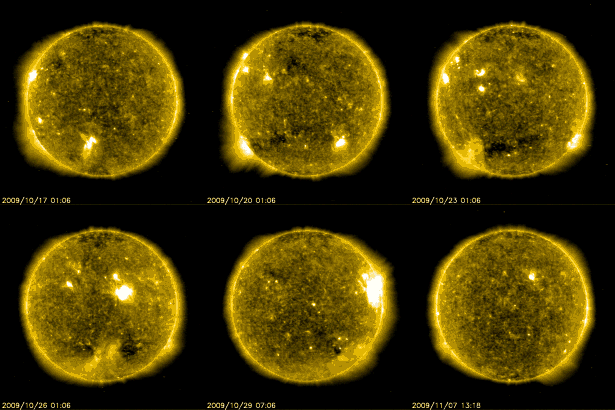
The surface of the Sun is always changing. We can call these changes the Sun's 'activity'. You can see this activity in the animation on this page. The magnetic field of the Sun makes the activity we can see on its surface. The bending and twisting of the Sun's magnetic lines creates sunspots and solar flares. Sometimes the Sun's magnetic field is more active than at other times. This is why the number of sunspots and flares varies from day to day, and year to year.
The Sun will carry on shining for another 5,000 million years. This period of time is called its main sequence. It will then begin run out of the nuclear fuel which powers its core and expand to a red giant star. Some stars explode once they run out of fuel. The Sun is not big enough to explode. Instead, it will lose its outer layers over a long time - we call this a planetary nebula. The central mass of the Sun will shrink to a dense white dwarf. Finally, it will dim, stop shining, and become a black dwarf.