

Ray Diagrams
Telescopes collect light from distant objects in space. They bring the light together at a focus. The focused image is viewed using the eye. Or the light can be measured using an instrument.
Not all telescopes focus light in the same way. Refracting telescopes use lenses. Reflecting telescope use mirrors.
We can use ray diagrams to compare types of telescope. These show the path that light takes.
Credit: The Schools' Observatory
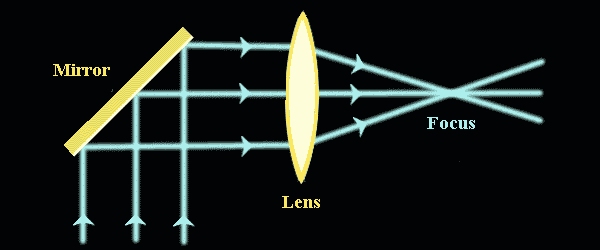
The ray diagram in the picture shows 3 'rays' of light entering the telescope. Each ray hits a mirror and is reflected off at 90 degrees. The 3 rays then pass through a glass lens. The light is refracted by the lens. Each ray exits the lens at a different angle. Together the mirror and lens 'steer' the rays so that they all meet at a chosen focus point. The focus is where the rays cross each other. A mirror can be used in place of the lens, but it must have a curved surface.
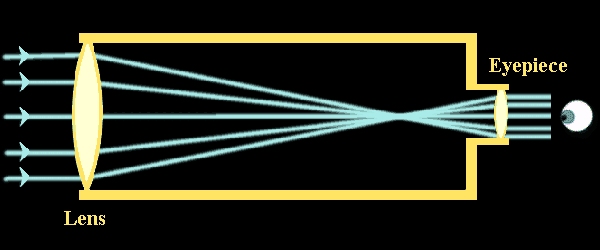
The light enters the telescope and is focused by the main lens. Another, smaller lens in the eyepiece magnifies the image. This makes it easier for us to see the image.
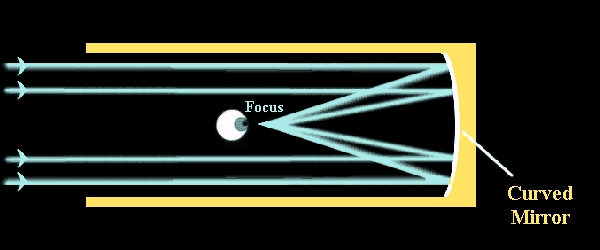
The light enters the telescope and is reflected off the large, curved mirror at the back. The light is focused inside the telescope. This makes it difficult to see the result. The telescope would need another mirror to move the focal point to somewhere more useful. Have a look at the ray diagrams for Newtonian and Cassegrain telescopes to see this in action.
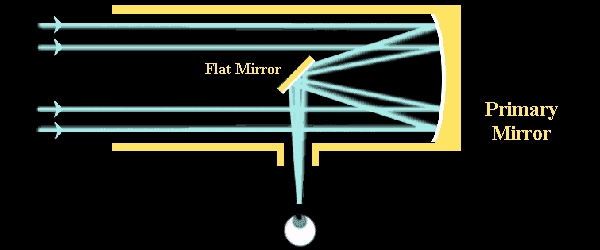
The light enters the telescope and is reflected off the concave primary mirror at the back. A smaller flat mirror reflects the light outside the telescope. The light is focused at a point where it can be viewed or measured.
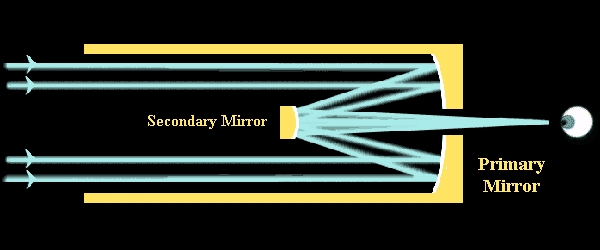
The light enters the telescope and is reflected off the concave primary mirror at the back. A convex secondary mirror reflects the light out through a hole in the primary mirror. The light is focused outside the telescope, where it can be viewed or measured.
Most modern professional telescopes are this type, including the Liverpool Telescope.